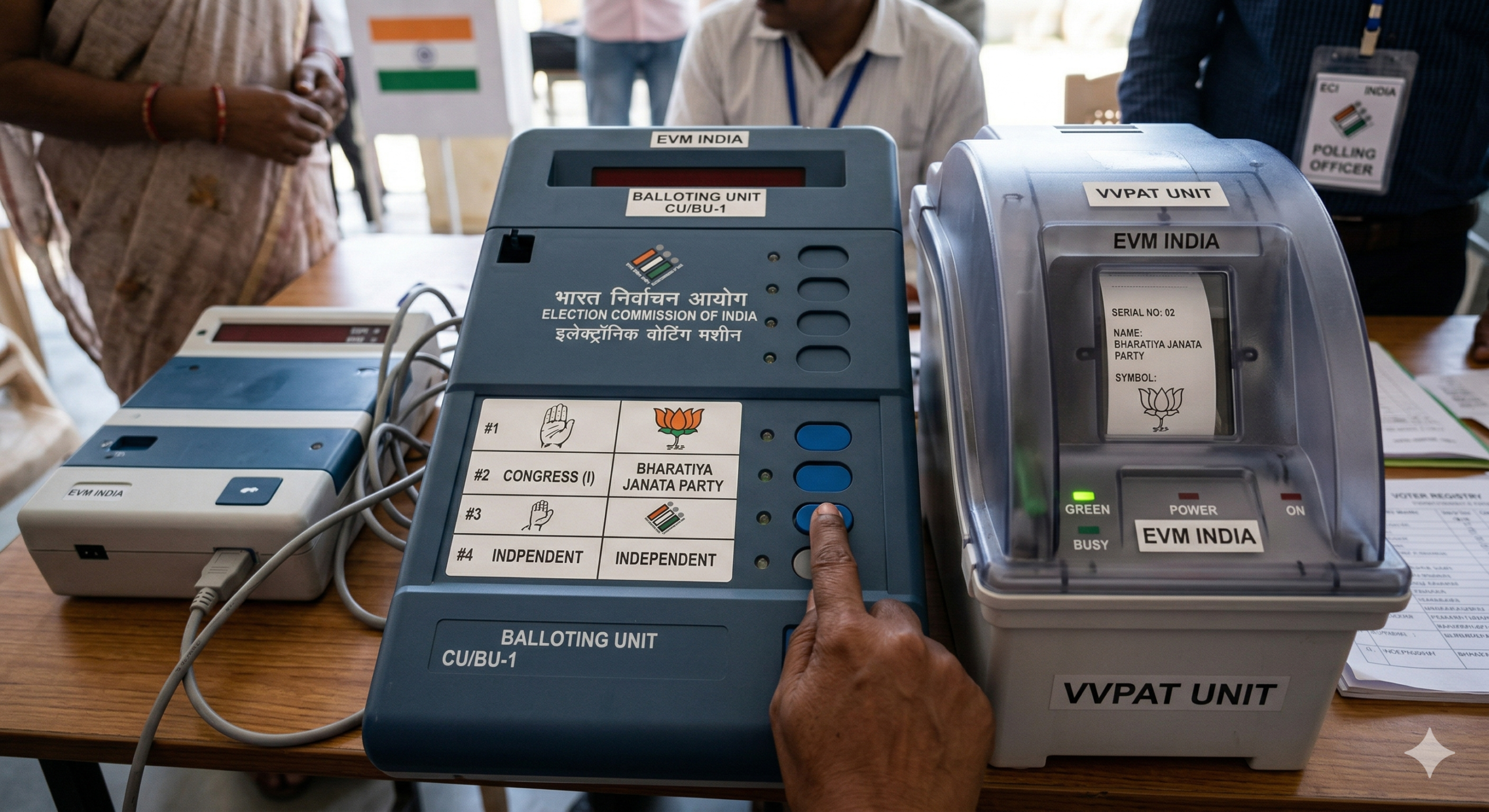
In an era where we use our smartphones for everything from ordering pizza to managing bank accounts, it feels only natural that our democracy runs on silicon chips too. But as 2026 rolls in, a fierce debate is sweeping across the globe: Are Electronic Voting Machines (EVMs) truly unhackable, or are we flirting with a digital disaster?
Whether you’re a tech enthusiast or a sceptical citizen, the “EVM vs. Paper” war is more than just a political talking point—it’s about the very foundation of trust. Let’s dive into the authenticity of EVMs and the high-tech (and low-tech) alternatives making waves today.
The Gold Standard or a Glitchy Mirage?
For decades, proponents have hailed EVMs as the saviour of the electoral process. The logic is simple: they eliminate “booth capturing,” stop the era of invalid paper votes, and deliver results at lightning speed.
Why EVMs are (theoretically) secure:
-
Standalone Sovereignty: Most modern EVMs (like those used in India) are not connected to the internet, Bluetooth, or any wireless network. You can’t hack what you can’t reach.
One-Time Programmable (OTP) Chips: The software is burned into the chip at the time of manufacture. It cannot be altered or rewritten later.
-
The VVPAT Safety Net: The Voter Verifiable Paper Audit Trail (VVPAT) allows you to see a physical slip of paper for 7 seconds, confirming your vote went exactly where you intended.
The Skeptic’s Corner:
Critics argue that no machine is truly “unhackable.” From concerns about the supply chain (who made the chips?) to the “black box” nature of the software, many fear that a sophisticated actor could manipulate the results before the machines even leave the warehouse.
The Rivals: What are the Alternatives?
If we ditch the EVM, what happens next? The world isn’t just going back to “ink and stamp.” We are seeing a hybrid evolution.
| Method | How it Works | The “Viral” Pro | The “Dealbreaker” Con |
| The Classic Paper Ballot | Hand-marked paper in a box. | 100% transparent and physical. | Slow, prone to human error/fraud. |
| Blockchain Voting | Secure, encrypted digital ledger. | Immutable and “hack-proof” math. | Vulnerable to malware on your phone. |
| Optical Mark Recognition (OMR) | Paper ballots scanned by a machine. | Best of both worlds (physical + fast). | Scanners can still have software bugs. |
| Biometric Voting | Fingerprint/Iris scan to unlock ballot. | Eliminates “ghost voters” entirely. | Massive privacy and data theft risks.
|
The 2026 Perspective: A “Trust, but Verify” Era
The consensus among cybersecurity experts in 2026 is shifting. It’s no longer about finding the perfect machine, but about total transparency. Many countries are now moving toward a Hybrid Model: voters use an electronic interface for ease of use, but a 100% manual count of paper slips (VVPATs) acts as the final legal word. This “Digital Front, Analog Back” approach bridges the gap between 21st-century speed and old-school security.
The Verdict
Is the EVM authentic? In its standalone, VVPAT-equipped form, it remains one of the most robust systems in history. However, authenticity isn’t just about the hardware—it’s about public confidence. Without open-source code or 100% paper audits, the “ghost in the machine” will always haunt the headlines.
What do you think? Would you trust a blockchain on your phone more than a machine at a polling booth? Let the debate begin!
Pro Tip: Next time you vote, don’t just press the button. Watch that VVPAT window. That tiny slip of paper is currently the most powerful “receipt” in the world.
Frequently Asked Questions (FAQs)
To help clear the air around the technology powering the world’s largest democracy, here are the most common questions regarding EVMs and their security.
1. Can an EVM be hacked via Bluetooth or Wi-Fi?
No. Indian EVMs are designed as “stand-alone” machines. They do not have any communication hardware like Wi-Fi, Bluetooth, or internet ports. Since they aren’t connected to a network, remote hacking—the kind you see in movies—is physically impossible.
2. What happens if the machine’s power fails during voting?
EVMs do not run on direct wall-socket electricity. They are powered by a built-in battery pack (usually a 7.5V alkaline battery). This ensures that even in areas with frequent power cuts, the voting process remains uninterrupted.
3. Can the internal software be changed after the machine is made?
The software is etched into a One-Time Programmable (OTP) chip. This means once the code is burned into the silicon during manufacturing, it cannot be overwritten, modified, or deleted. Think of it like a printed book; you can’t change the words once the ink is dry.
4. How does the VVPAT actually help the voter?
The Voter Verifiable Paper Audit Trail (VVPAT) is your physical receipt. When you press a button on the Balloting Unit, a slip is printed inside a sealed glass box showing the candidate’s serial number, name, and symbol. It stays visible for 7 seconds before falling into a secure drop box, allowing you to verify your vote instantly.
5. Who manufactures these machines? Is it a private company?
No private entities are involved in the core manufacturing. In India, EVMs are produced exclusively by two Government of India Undertakings:
Bharat Electronics Limited (BEL)
Electronics Corporation of India Limited (ECIL)
6. Are EVMs used in other countries?
Yes, but the technology varies. Many countries like the USA, Brazil, and Estonia use various forms of electronic voting. However, some European countries (like Germany) moved back to paper ballots, not necessarily because the machines were hacked, but because the courts ruled that the process must be “publicly transparent” without requiring specialized tech knowledge to understand.
7. What is the “Totalizer” and why is it debated?
The Totalizer is a proposed mechanism that allows for the counting of votes from several EVMs simultaneously. Currently, votes are counted booth-by-booth, which can reveal the voting patterns of specific neighborhoods. The Totalizer would hide these patterns to protect the privacy of voters in specific localities.
8. If a machine malfunctions, does it lose the votes already cast?
No. The votes are stored in the permanent memory of the Control Unit. If a machine stops working, it is replaced with a new one, but the data inside the original “Control Unit” remains safe and is retrieved during the counting day.